World
Discovering the glamor up in the sky
(Agencies)
Updated: 2010-12-28 12:15
 |
Large Medium Small |
|
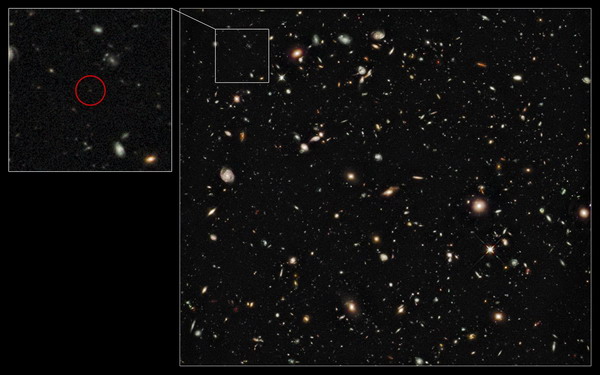 This image shows the infrared Hubble Ultra Deep Field taken by the NASA/ESA Hubble Space Telescope in 2009, in which several robust candidate distance-record-breaking objects were discovered. Confirming the distances to such faint and remote objects is however an enormous challenge and can only reliably be done using spectroscopy from very large ground-based telescopes by measuring the redshift of the galaxy's light. Astronomers using ESO's Very Large Telescope (VLT) have measured the distance to the most remote galaxy so far, UDFy-38135539, existing when the Universe was only about 600 million years old (a redshift of 8.6). At this early time, the Universe was not fully transparent and much of it was filled with a hydrogen fog that absorbed the fierce ultraviolet light from young galaxies. Astronomers have spotted the oldest galaxy ever seen, one born just 600 million years after the Big Bang. Their report, published in the journal Nature on Oct 20, 2010, confirms that the distant smudge first spotted by the orbiting Hubble Space Telescope is the farthest and thus oldest object ever imaged. [Photo/Agencies]
|
|
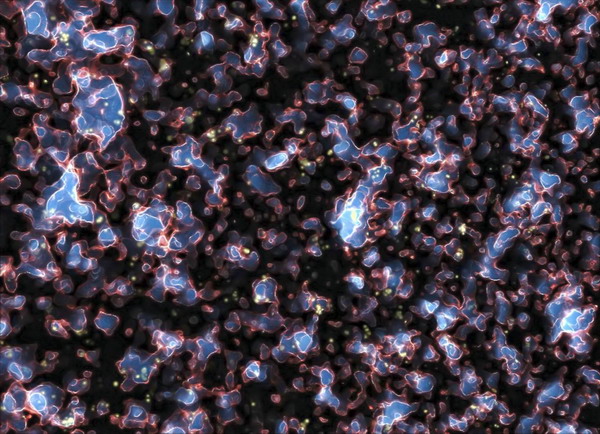 This illustration shows the transitional period when the fog was still being cleared by this ultraviolet light is known as the era of reionisation, illustrated with this still from a representative scientific simulation, released to Reuters Oct 20, 2010. Astronomers using ESO's Very Large Telescope (VLT) have measured the distance to the most remote galaxy so far, UDFy-38135539, existing when the Universe was only about 600 million years old (a redshift of 8.6). [Photo/Agencies]
|