


Losa Gyatso with the monastery's management committee says Drakpa Gyaltsen, head of the Shalu area during the Yuan Dynasty, presented himself in front of Emperor Renzong and was granted a gold imperial decree, a jade seal, as well as offerings, including gold and silver.
"With the offerings from the emperor and many Han craftsmen invited here to build the monastery, the project has become a symbol for communication, exchanges, integration and unity of different ethnic groups," says Losa Gyatso.
In the Yuan Dynasty, the central government exercised jurisdiction and governance over Tibet.
The earliest archaeological site identified at the heart of the Qinghai-Tibet Plateau so far is the Nwya Devu site, located 4,600 meters above sea level, in northern Tibet. More than 4,000 stone artifacts, including blades, chunks and tools, have been recovered at the Paleolithic site since 2016.
Scientific analysis showed that the site dates back some 40,000 to 30,000 years, says Zhang Xiaoling from the Institute of Vertebrate Paleontology and Paleoanthropology, Chinese Academy of Sciences, adding that it is also the highest Paleolithic site in altitude found in the world so far.
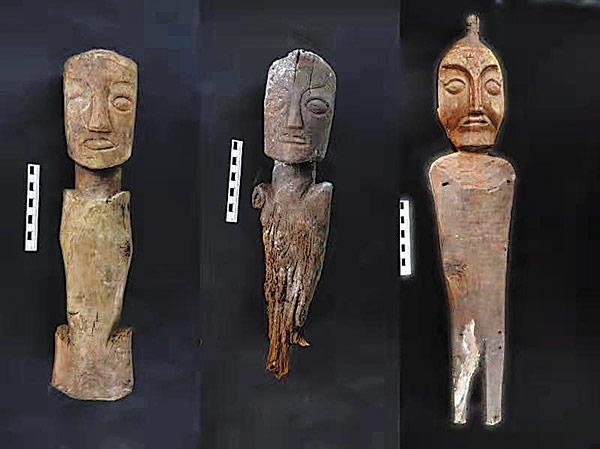
Archaeological findings throughout Tibet's history have also provided abundant evidence of cultural integration. For example, the wooden figurines unearthed from the Sangmda Lungga tomb site in Zada county in Tibet's Ngari prefecture are similar in shape to those found in the tombs in the neighboring Xinjiang Uygur autonomous region.
He Wei, an associate researcher with the regional cultural relics protection research institute, says the relics site spanning from 366 BC to AD 668 witnessed political and economic development, integrating multiple cultures from the surrounding areas, such as those in Xinjiang and the areas in central China.
The cultural connection between Tibet and the Yellow River basin was proved at the Karub ruins in the city of Chamdo with the discovery of the millet, a crop customarily planted in northern China. The finding proved the communication between the plateau and northern China some 5,000 years ago.





